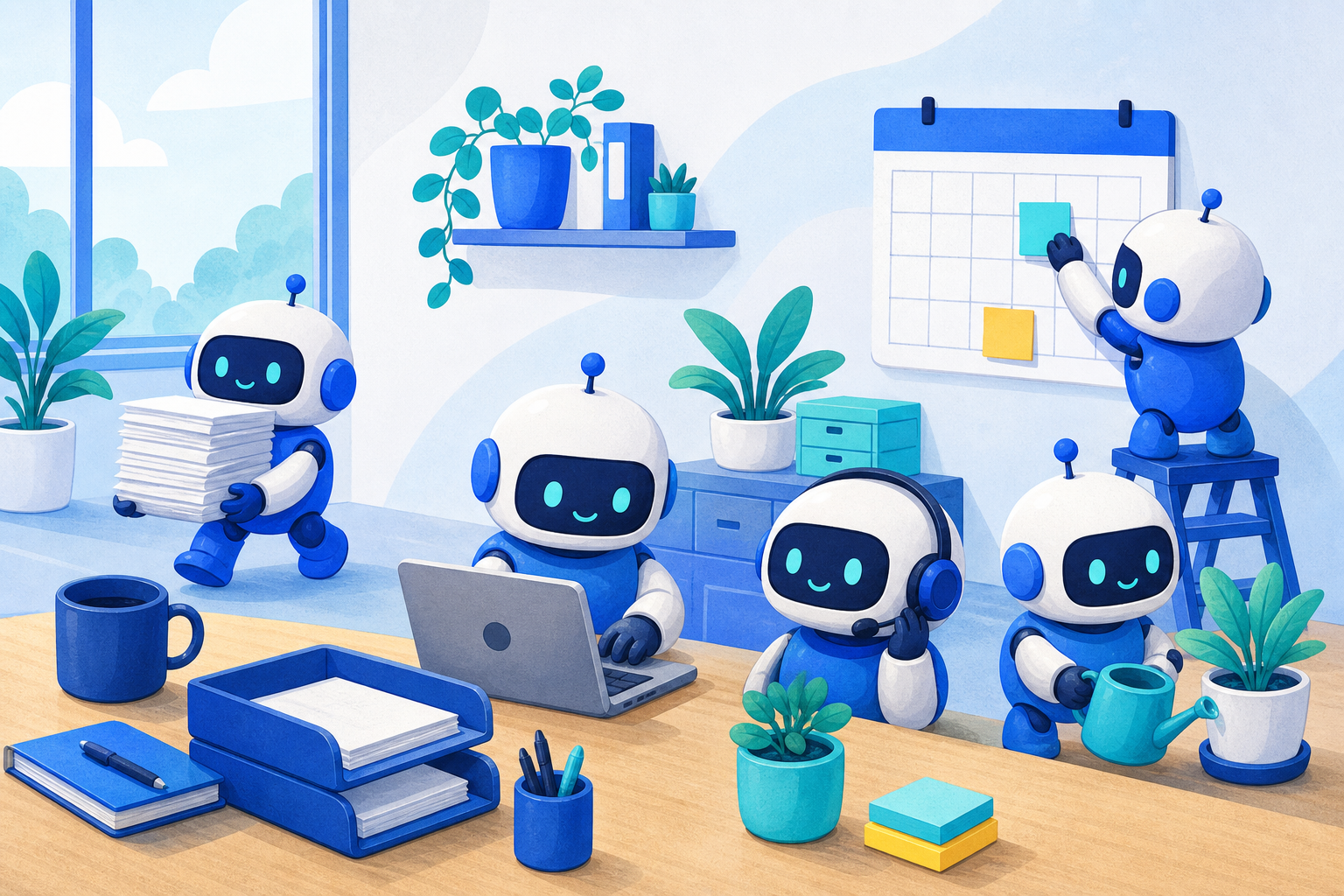
Quick answer: An AI employee is a digital worker that owns a whole job function, not a single task. It reads your business information, makes a decision, and finishes the job. That is the difference between an automation and a teammate.
Most business owners we speak to are not short on tools. They have a CRM, a booking link, a few automations and an inbox that still eats their evenings. The tools are all sitting there waiting to be told what to do. That is the bit that breaks.
An AI employee flips it. You hand over the outcome, not the steps.
What is an AI employee?
An AI employee is an agentic AI system that completes a role end to end. It has a defined job, access to your tools, and knowledge of how your business actually works, so it can choose a path rather than follow one.
Ours is called Viktor. He sits inside our business the same way a staff member would, with logins, a task list, a set of written instructions we improve every week, and a manager, which is us.
A few things he does on any given day:
- Reads the inbox each morning and briefs us on what needs a human
- Drafts client replies in our voice and waits for approval before anything sends
- Writes and schedules social content
- Runs SEO reporting and flags what moved
- Updates client sites after taking a backup first
None of that is one prompt in ChatGPT. It is a role.
AI employee vs automation: the real difference
Traditional automation is if this, then that. It is brilliant when the input is predictable and useless the moment it is not. A form field changes, a client phrases something oddly, and the chain quietly fails. Then you become the maintenance department for your own automations.
Agentic AI reasons about the situation first.
| Automation | AI employee | |
|---|---|---|
| Trigger | One fixed event | A goal or a standing brief |
| Handles surprises | Breaks | Decides, or asks |
| Knowledge | Whatever you hard coded | Your documents, past work, brand voice |
| Improves | Only when you rebuild it | Every time you correct it |
Automation follows a path. An AI employee chooses one.
The part people underestimate is the last row. Correct an AI employee once and it holds that correction. That compounds in a way an automation never does.
Why should your business care?
Because the bottleneck in most small Australian service businesses is not strategy. It is capacity. Nobody has a spare hour to write the follow up email, chase the review, or update the website.
Speed of response decides who wins the job. If an enquiry sits until tonight, the customer has already spoken to someone else. A digital worker answers while you are on site.
The admin load is where good businesses stall. Quoting, invoice chasing, reporting, content. All necessary, none of it billable.
Search itself has changed. Buyers ask ChatGPT and Google’s AI answers before they ask a mate. Being the business those systems recommend takes consistent, well structured content, and that takes output you probably do not have time to produce manually.
Where to start: your first digital hire
Do not hire a generalist. Pick one job with a clear finish line.
- First responder. Answers every enquiry within minutes, qualifies it, books the call.
- Follow up. Chases quotes that went quiet and asks for reviews after a job.
- Content and visibility. Blogs, Google Business Profile posts and social, done to a schedule.
- Reporting. Pulls the numbers weekly so you stop guessing.
Pick the one that annoys you most. That is usually the one with the fastest payback.
How we onboard an AI employee
We treat it like a staff induction, because that is what it is. The training phase is where the results come from, and it is the step people try to skip.
- Define the role. What does done look like, and what is off limits. Boundaries first.
- Connect the tools. Email, calendar, CRM, website, socials, reporting. An AI employee with no access is just a chatbot.
- Train it on your business. Pricing, services, past emails, tone, and the things you would never say. We use Australian English and local phrasing so clients hear your business, not a call centre.
- Test before it goes near a customer. We run scenarios, including the awkward ones, and tighten the instructions until the answers are right.
- Launch with a human in the loop. Approvals stay on until the trust is earned, then we loosen them role by role.
- Keep coaching. Every correction becomes a written instruction it keeps. That is the compounding bit.
Key takeaway: The training phase is the whole job. An AI employee you never correct stays average. One you coach for a month starts sounding like your best staff member.
There is more on the mindset shift in our post on why you do not need to understand AI to use it in your business.
How to know it is working
Measure it like a hire, not a gadget.
- Hours returned to you each week
- Speed to first response on enquiries
- Enquiries answered outside business hours
- Quotes followed up that would have gone cold
- Content published on schedule
If it is not moving one of those, the role was defined too vaguely. That is a fixable problem, and usually a fifteen minute conversation.
Where this goes next
The interesting future is not a business run by AI. It is a small team where the repetitive work is handled and the humans do the parts that need judgement, taste and a relationship.
Most small businesses will have a digital worker on the team within a couple of years, in the same unremarkable way they have a bookkeeper. The ones that start now will simply have a better trained one.
If you want the detail on what a digital worker actually does day to day, we have set it out on our AI agent installs page. And if you want to see what your first AI employee could take off your plate, book an AI Direction Session and we will map it out with you.
Common questions